
Nucleofill
Showing all 3 results
NUCLEOFILL® Regenerative Biostimulators: The Definitive Technical Guide to Polynucleotide (PDRN) Cellular Rejuvenation
In contemporary regenerative aesthetics, the treatment paradigm has shifted away from temporary volumetric concealment toward active cellular repair. Traditional dermal fillers rely on crosslinked hyaluronic acid to mechanically expand the extracellular matrix, masking signs of aging without altering cellular vitality. In contrast, the next generation of aesthetic medicine prioritizes biological tissue restructuring.
To meet this clinical demand, Italian medical-aesthetic pioneer Promoitalia engineered Nucleofill®. Positioned as a premier line of bio-restructuring, highly purified polynucleotide (PN) gels, Nucleofill operates at a molecular level to restore skin elasticity, neutralize free radicals, and rebuild structural integrity from within.
For high-volume medical spas, plastic surgery clinics, and international aesthetic distributors, stocking the complete Nucleofill ecosystem ensures access to a highly sought-after, scientifically backed treatment range. Below, we break down the polymer science behind polynucleotides, analyze the specific target indications for each product variant, outline clinical delivery protocols, compare the range against key market competitors, and detail inventory management guidelines for maximum practice profitability.
The Core Biochemistry: How Polynucleotides Drive Cellular Repair
The therapeutic efficacy of Nucleofill is driven by highly purified, high molecular weight polynucleotide (PN) chains extracted and purified from salmon DNA. These natural fragments work through a multi-pathway mechanism that sets them apart from basic moisturizing skin boosters:
-
Adenosine $A_{2A}$ Receptor Activation: Once injected into the deep dermis, polynucleotide fragments serve as specific agonists for cell-surface adenosine receptors. This binding triggers a powerful intracellular cascade that shifts localized fibroblasts out of a quiescent (dormant) state into an active, productive state.
-
True Neocollagenesis & Elastin Synthesis: Activated fibroblasts accelerate the production of native Type I collagen, functional elastin fibers, and endogenous hyaluronic acid. This structural synthesis increases dermal thickness and improves skin retraction and elasticity.
-
The Scavenger & Anti-Radical Mechanism: The polymeric structure of polynucleotides features a dense chemical arrangement capable of neutralizing free radicals. By trapping reactive oxygen species (ROS), Nucleofill shields cells from the oxidative stress induced by UV exposure, smoking, and urban air pollution.
-
Deep Isosmotic Hydration: The long, hydrophilic polymer chains bind water molecules tightly within their three-dimensional grid. This creates a continuous, long-term reservoir of isosmotic hydration in the deeper dermal layers, improving overall skin turgor and light-reflective qualities.
The Nucleofill® Product Ecosystem: Calibrated Variances
To address distinct anatomical zones and tissue densities, Promoitalia has structured the Nucleofill line into distinct formulations. Each variant features a specific polynucleotide concentration and viscosity profile to match its clinical application.
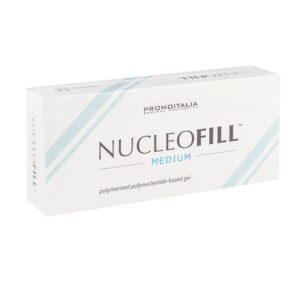
1. Nucleofill® Medium
-
Biochemical Profile: Contains a 2.0% concentration of highly purified polynucleotides with a molecular weight of approximately 1,500 kDa.
-
Primary Indications: Engineered for the correction of early to moderate photo-aging, shallow expression lines, superficial scarring, and generalized skin dehydration.
-
Target Areas: Ideal for the mid-face, forehead, neck, and the backs of the hands in younger to middle-aged demographics.
2. Nucleofill® Strong (Also distributed as Strong Plus)
-
Biochemical Profile: Features a concentrated 2.5% polynucleotide matrix possessing a high viscosity and an elevated molecular weight of around 2,500 kDa.
-
Primary Indications: Developed for mature skin exhibiting advanced chronological aging, distinct flaccidity, deeper structural wrinkles (such as nasolabial folds), stretch marks, and extensive fibrotic scar tissue.
-
Target Areas: Recommended for deep structural lifting of the cheeks, lower face contours, décolleté, abdomen, thighs, and gluteal regions.
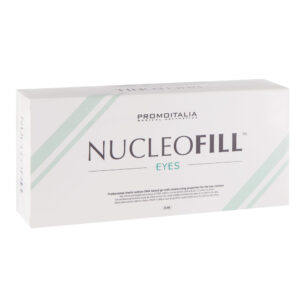
3. Nucleofill® Soft Plus Eyes (Nucleofill Eyes)
-
Biochemical Profile: A low-density, low-viscosity formulation calibrated at a gentle 0.75% polynucleotide concentration. Supplied as a sterile 2.0 ml syringe.
-
Primary Indications: Specifically engineered for the delicate, hyper-fragile tissue of the periocular region. It treats hollow tear troughs, periorbital fine lines (“crow’s feet”), thinning dermal layers, and vascular dark circles.
-
Target Areas: Upper and lower eyelids, periorbital borders, and temporary structural hollows beneath the eyes.
4. Nucleofill® Medium Plus Hair
-
Biochemical Profile: A unique 2.0% polynucleotide configuration tailored to improve the microenvironment of the hair follicle bulb. Delivered in a 2.0 ml syringe.
-
Primary Indications: Indicated for the treatment of androgenetic alopecia, telogen effluvium, postpartum hair thinning, and general follicle weakening. It enhances bulb nourishment, improves local microcirculation, and extends the anagen (growth) phase of the hair cycle.
-
Target Areas: Scalp, hairline, and eyebrow matrices.
Clinical Placement Protocols and Injection Methodologies
To safely achieve optimal cell signaling, practitioners must apply precise delivery methods tailored to each Nucleofill variant.
-
The Bio-Aesthetic Points (BAP) / 5-Point Lifting Protocol: Primarily utilized for Nucleofill Strong across the mid and lower face. Practitioners inject larger deposits into 5 anatomically selected zones on each side of the face where major lymphatic pathways and dermal retention ligaments cross. This maximizes structural lifting while minimizing injection discomfort and downtime.
-
Recommended Treatment Cycles: Because biological tissue remodeling operates on a progressive timeline, a single session is not sufficient. The standard clinical protocol demands 2 to 3 initial treatments spaced 2 to 4 weeks apart, followed by a single maintenance treatment every 6 months to maintain fibroblast activity.
Comprehensive Competitive Landscape Analysis
To assist procurement directors and clinical owners in managing their product portfolio, the table below highlights how Nucleofill compares with other leading injectable biostimulators and skin boosters on the market.
| Technical Parameter | NUCLEOFILL® (Promoitalia) | Plinest® / PhilArt® | Profhilo® | Sculptra® |
| Active Substance Class | Polynucleotides (PN) (Highly purified salmon DNA fragments). | Polynucleotides (PN) / Polydeoxyribonucleotides (PDRN). | High & Low Molecular Weight Hybrid Hyaluronic Acid. | Poly-L-Lactic Acid (PLLA) Microparticles. |
| Primary Mode of Action | Cellular Biostimulation: receptor binding + free radical scavenging. | Cellular regeneration and fibroblast activation. | Mechanical tissue remodeling via thermal HA diffusion. | Foreign-body inflammatory response triggering deep neocollagenesis. |
| Volumetric Contribution | Low to None (Focuses on skin quality, density, and elasticity). | Minimal (Designed for skin quality and hydration). | Intermediate (Hydro-lifting and contour softening). | High (Reconstitutes deep structural fat pads and bony resorption). |
| Fish/Salmon Allergy Risk | Yes (Strictly contraindicated for individuals with fish allergies). | Yes (Derived from piscine sources). | No (Fermentation-derived pure hyaluronic acid). | No (Synthetic biocompatible polymer matrix). |
| Anatomical Versatility | High (Specific variants for face, body, hair, and delicate eyes). | High (Available in face, eye, and body configurations). | Moderate (Mainly used for face, neck, hands, and body BAP points). | Restrained (Strictly avoided in the periorbital and perioral zones). |
Key Takeaways for Clinical Positioning:
-
Nucleofill vs. Profhilo: Profhilo utilizes concentrated hyaluronic acid to create rapid, sweeping moisture diffusion and an intermediate hydro-lifting effect across tissue planes. However, it does not possess specific nucleotide structures to directly target hair follicles or repair the delicate periorbital skin. Nucleofill provides less immediate structural volume but delivers superior long-term biological repair, making it safer for thin, puffiness-prone eye zones.
-
Nucleofill vs. Sculptra: Sculptra relies on PLLA microparticles to cause a controlled, localized inflammatory response that builds deep structural volume over several months, making it excellent for hollow cheeks. However, it cannot be safely injected into the fragile upper eyelids or the scalp. Nucleofill operates via non-inflammatory receptor paths, offering a highly versatile tool for thin skin, fine wrinkles, periocular repair, and hair restoration.
Wholesale Sourcing, Storage, and Global Logistics Integrity
Because a standard clinical protocol requires a multi-session regimen, clinic supply managers experience rapid turnover of the Nucleofill range. Sourcing these products in volume via authorized B2B wholesale portals allows practices to unlock significant tier discounts, which lowers the cost-per-syringe and enables the creation of competitive multi-session treatment packages.
When purchasing Nucleofill online, clinics must verify supplier logistics chains to preserve the structural integrity of the polynucleotide chains:
Storage & Shipping Standards: Polynucleotide molecular structures are sensitive to extreme thermal fluctuations. Nucleofill boxes must be stored in a controlled environment between 2°C and 25°C, away from direct heat sources, ambient moisture, or freezing temperatures. Freezing temperatures can break the delicate polymeric bonds, rendering the biostimulating solution clinically ineffective. Sourcing managers should only buy from trusted distributors who offer original Promoitalia batch tracking numbers, intact factory security seals, and temperature-monitored shipping options.
Frequently Asked Questions (FAQs)
1. Is Nucleofill a traditional dermal filler?
No. Nucleofill does not contain crosslinked hyaluronic acid and is not designed to create immediate artificial volume or alter facial geometry. It is a regenerative biostimulator that works at a cellular level, encouraging the body to produce its own collagen and elastin to naturally thicken and firm the skin over time.
2. Can Nucleofill be injected into patients with a seafood allergy?
No. Because the active polynucleotide chains are derived and purified from salmon DNA, Nucleofill is strictly contraindicated for individuals with a known allergy to fish, shellfish, or marine products. For these patients, non-marine biostimulators or pure hyaluronic acid products should be used instead.
3. How soon will patients see visible results from a treatment?
Initial hydration improvements and a brighter complexion can often be observed within the first week after the initial session. However, because true cellular remodeling takes time, the most significant improvements in skin firmness, lift, and wrinkle reduction develop progressively over 2 to 4 weeks following the second session.
4. What is the expected post-treatment downtime?
Downtime is minimal. When using the micro-papular mesotherapy technique, patients will develop small, visible bumps at the injection sites. These papules are a normal part of the process and typically resolve within 24 to 48 hours as the viscoelastic gel absorbs into the surrounding tissue. If a cannula is used via the BAP technique, surface downtime is almost invisible, though minor pinpoint bruising may occasionally occur.
5. Can Nucleofill be combined with Botulinum Toxin or Dermal Fillers?
Yes, it pairs excellently with other aesthetic treatments. While Botulinum Toxin relaxes underlying muscles to soften dynamic expression lines and fillers restore lost volume, Nucleofill repairs the biological quality of the skin tissue itself. Practitioners recommend waiting 2 weeks between treatments to allow the tissue to fully settle.
6. What are the absolute clinical contraindications for Nucleofill?
Nucleofill must not be administered to pregnant or breastfeeding women, individuals with active skin infections, herpes outbreaks, or open wounds in the treatment zone, or patients with a known fish allergy. It is also completely contraindicated for anyone with active systemic autoimmune disorders, unstable diabetes, or those undergoing current oncological therapies.
