Neuramis

Showing all 4 results

NEURAMIS® Premium Dermal Fillers: The Ultimate Guide to SHAPE™ Technology and Cross-Linked Hyaluronic Acid Volumization

In the highly competitive market of non-surgical facial rejuvenation, Hyaluronic Acid (HA) dermal fillers are the cornerstone of modern aesthetic practices. Patients demanding facial contouring, lip augmentation, and wrinkle correction look for three primary performance factors: immediate, natural-looking results, excellent tissue integration that avoids unnatural lumps, and long-lasting volume stability. For medical professionals, the primary requirements are smooth injection mechanics, a predictable safety profile, and an efficient cost structure that supports strong clinic profitability.

To meet these clinical and commercial demands, South Korean biopharmaceutical leader Medytox (celebrated for its advanced botulinum toxin research) engineered Neuramis®. Holding extensive international health certifications, Neuramis is an elite portfolio of monophasic, cross-linked hyaluronic acid fillers. Utilizing a patented, multi-stage manufacturing matrix known as SHAPE™ Technology, the Neuramis product line delivers exceptional purity, high structural elasticity (G-prime), and outstanding biographical compatibility, making it one of the most reliable and globally utilized filler brands in aesthetic medicine today.

For medical spas, dermatology clinics, and global aesthetic distributors looking to optimize their clinical outcomes and maximize revenue, Neuramis represents a foundational inventory asset. Below, we examine the underlying polymer science of Neuramis, break down the specialized clinical indications for each variant in the product line, compare its performance with other dominant global brands, and detail the commercial advantages of bulk wholesale sourcing.

The Science of Neuramis®: Patented SHAPE™ Technology

The exceptional longevity and smooth handling of Neuramis are a direct result of its specialized manufacturing process. While standard HA fillers can suffer from uneven cross-linking or high residual chemical impurities, Medytox utilizes a refined engineering protocol:

  • SHAPE™ Technology (Stabilized Hyaluronic Acid & Purification Process): This two-stage manufacturing method optimizes cross-linking efficiency. By precisely cross-linking pure, micro-refined hyaluronic acid molecules with a specialized BDDE matrix, the process creates a highly cohesive, monophasic gel structure that resists natural enzymatic degradation (hyaluronidase) and maintains its volume over extended periods.

  • Multi-Stage Purification Matrix: Following cross-linking, the gel undergoes a rigorous, multi-step wash-and-dialysis sequence. This step extracts virtually all unreacted BDDE molecules and limits trace endotoxins to well below standard regulatory levels. This low residual profile significantly reduces the risk of post-treatment swelling, redness, and delayed-onset hypersensitivity reactions.

  • Monophasic Cohesivity and Flow: Neuramis is formulated as a completely monophasic gel, ensuring a uniform distribution of HA particle sizes. For the injector, this translates into a smooth, consistent extrusion force during administration, allowing for precise control and a natural, even integration into the patient’s delicate facial tissues.

The Neuramis® Product Portfolio: Portfolio Segmentation

The Neuramis family is precisely segmented into distinct variants, each engineered with a unique gel density, viscosity, and placement depth to target specific anatomical zones.

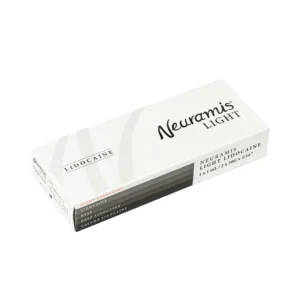
1. Neuramis® Light Lidocaine

  • Rheological Profile: The lowest viscosity and highest fluidity within the product range. Housed in a $1.0\text{ mL}$ syringe and infused with $0.3\%$ lidocaine to maximize patient comfort.

  • Target Depth: Superficial to mid-dermis layers.

  • Clinical Applications: Designed to smooth out fine, superficial surface wrinkles, treat delicate perioral lines (smoker’s lines), and improve moisture and hydration in fragile areas like the neck, décolleté, and back of the hands.

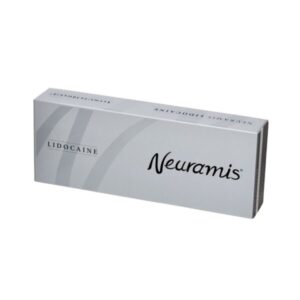
2. Neuramis® Lidocaine (Standard)

  • Rheological Profile: A versatile, balanced monophasic gel combining smooth extrusion mechanics with medium elasticity. Contains 0.3% lidocaine.

  • Target Depth: Mid-to-deep dermis layers.

  • Clinical Applications: The gold standard within the line for correcting moderate facial wrinkles, treating early nasolabial folds, smoothing marionette lines, and performing natural lip augmentations focused on soft definition and hydration.

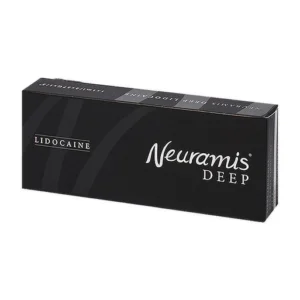
3. Neuramis® Deep / Neuramis® Deep Lidocaine

  • Rheological Profile: Formulated with a higher G-prime and density to provide robust structural support. Available with or without integrated lidocaine.

  • Target Depth: Deep dermis to the upper subcutaneous layers.

  • Clinical Applications: Optimized for structural volume restoration. It is highly effective for smoothing deep nasolabial folds, lifting prominent marionette lines, adding structural volume to the lips, and filling temple hollowing.

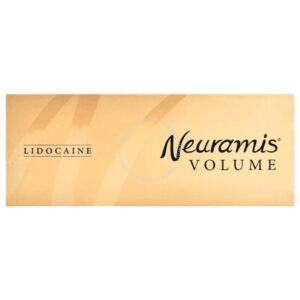
4. Neuramis® Volume Lidocaine

  • Rheological Profile: The highest density, viscosity, and G-prime within the Neuramis portfolio. Engineered specifically to withstand muscular compression and deliver significant structural projection. Contains 0.3% lidocaine.

  • Target Depth: Deep subcutaneous layer or pre-periosteal (supra-periosteal) placement on the bone.

  • Clinical Applications: Non-surgical facial sculpting, including chin augmentation, sharp jawline contouring, malar (cheek) volume restoration, and non-surgical rhinoplasty adjustments.

Technical Comparison: Neuramis vs. Global Competitors

To assist procurement managers, clinical directors, and purchasing agents in organizing a balanced clinical menu, it is valuable to compare Neuramis with other market-leading dermal filler brands, such as Juvederm®, Restylane®, and Revolax®.

Characteristic NEURAMIS® (Medytox) Juvederm® (Vycross Range) Restylane® (NASHA Range) Revolax® (Across)
Gel Architecture Monophasic (Highly cohesive and uniform). Monophasic (Smooth, cross-linked matrix). Biphasic (Particulate, structured gel). Monophasic (High-density, cohesive gel).
Core Technology SHAPE™ Technology (Two-stage purification). Vycross Technology (Low + High MW mix). NASHA Technology (Firm, calibrated particles). High-density cross-linking matrix.
Extrusion Dynamics Smooth and Consistent (Low injection pressure). Very smooth, low resistance. Higher resistance (Requires firm, controlled pressure). Smooth, firm flow.
Post-Op Swelling Risk Very Low (Due to ultra-low residual BDDE). Low to Moderate. Moderate (Biphasic HA absorbs water rapidly). Low.
Reversibility Highly Responsive (Dissolves rapidly with Liporase). Responsive to Hyaluronidase. Responsive to Hyaluronidase. Responsive to Hyaluronidase.
Value-to-Volume Tier Exceptional Commercial ROI (Premium results at competitive wholesale pricing). High luxury overhead (Premium unit acquisition cost). Premium corporate brand pricing. High volume, value-driven market tier.

Key Takeaways for the Practitioner:

  • Neuramis vs. Restylane (Biphasic): Restylane uses a biphasic, particulate structure that provides excellent firm lifting capacity, but it can occasionally feel firm or form small lumps if placed incorrectly in highly mobile facial areas. Neuramis, as a monophasic gel, flows more uniformly into the tissue gaps. This smooth dispersion delivers a softer, more natural texture immediately post-injection, making it highly versatile for dynamic zones like the lips and cheeks.

  • Neuramis vs. Juvederm: While Juvederm’s Vycross line is highly regarded for its longevity, its premium brand overhead can significantly inflate a clinic’s operational costs. Neuramis delivers comparable clinical durability, excellent safety profiles, and high patient satisfaction while lowering the clinic’s acquisition cost-per-syringe. This makes it an ideal option for building competitive, profitable treatment packages.

Wholesale Sourcing, Storage Stability, and Practice Growth

Because achieving complete facial rejuvenation often requires treating multiple facial zones during a single patient visit (such as combining mid-face cheek lifting with nasolabial smoothing), high-volume aesthetic clinics experience rapid inventory turnover. This fast-paced consumption makes bulk wholesale sourcing an essential operational practice.

Purchasing Neuramis wholesale through licensed medical e-commerce channels offers significant volume discounts. Minimizing your initial cost-per-syringe gives your practice the financial flexibility to adjust package pricing, design seasonal aesthetic promotions, and maintain strong profit margins. This approach helps attract a broader client base while ensuring consistent product availability for your practitioners.

When sourcing Neuramis online, strict quality assurance and logistics standards must be maintained. True Neuramis uses refined polymer chains that are sensitive to extreme temperature changes. To preserve the stability of the cross-linked gel network and prevent premature breakdown, the product must be stored at room temperature—ideally between 2°C and 25°C—away from direct sunlight or freezing conditions. Buyers should purchase exclusively through verified aesthetic supply distributors who guarantee authentic manufacturing from Medytox, intact sterile packaging, clear batch tracking numbers, and reliable shipping logistics.

Frequently Asked Questions (FAQs)

1. How long do the visible results of a Neuramis treatment typically last?

The durability of Neuramis results depends on the specific variant used, the treatment zone, and the patient’s individual metabolic rate. On average, Neuramis Lidocaine and Deep last between 9 to 12 months, while the highly dense Neuramis Volume can maintain structural projection for up to 12 to 24 months. Areas with high muscle movement, such as the lips, tend to process the gel more quickly than static areas like the chin or nose.

2. Is Neuramis fully reversible if a patient is unhappy with the result?

Yes, absolutely. Because Neuramis is formulated entirely from pure, cross-linked hyaluronic acid without any permanent synthetic additives, it is fully reversible. If a patient experiences asymmetry, overcorrection, or an accidental vascular occlusion, the gel can be dissolved quickly and completely by injecting a reversing enzyme like Liporase (Hyaluronidase) directly into the treated pocket.

3. What is the typical patient recovery profile following an injection?

Downtime after a Neuramis treatment is minimal. Patients can generally return to work and light everyday activities immediately following their appointment. Mild, localized side effects—such as swelling, redness, a feeling of firmness, and light bruising around the injection sites—are normal inflammatory responses that typically resolve within 2 to 7 days. Applying cold compresses can help speed up this recovery process.

4. Why does Neuramis cause less post-injection swelling compared to alternative brands?

Post-injection swelling is frequently triggered by residual unreacted cross-linking agents (BDDE) or chemical endotoxins left behind during manufacturing. Neuramis utilizes Medytox’s rigorous SHAPE™ Purification Process, which washes the cross-linked gel repeatedly to remove these impurities. This results in an ultra-pure product that minimizes tissue irritation and reduces immediate post-procedure swelling for the patient.

5. What are the essential post-care guidelines for patients receiving fillers?

To ensure the filler sets correctly and integrates smoothly into the tissue, patients should avoid touching, rubbing, or applying heavy pressure to the treated zones for the first 24 to 48 hours. Strenuous exercise, saunas, steam rooms, solariums, and alcohol consumption should be avoided for 48 hours post-injection to prevent additional swelling or bruising.

6. What are the absolute clinical contraindications for a Neuramis treatment?

Neuramis must never be administered to pregnant or breastfeeding women, individuals with a known allergy or hypersensitivity to hyaluronic acid or lidocaine, or patients presenting with active skin infections, herpes outbreaks, or open wounds in the target treatment area. It is also completely contraindicated for individuals managing active systemic autoimmune disorders, blood clotting deficiencies, or those taking heavy immunosuppressive medications.

Trustpilot