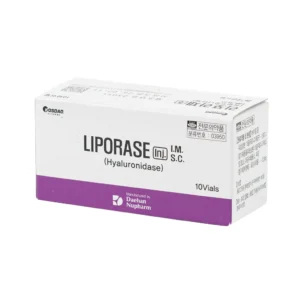
Liporase
Showing the single result
LIPORASE® Injectable Hyaluronidase: The Essential Guide to Dermal Filler Reversal and Aesthetic Emergency Management
In the rapidly expanding field of injectable aesthetics, the ability to manage complications and fine-tune outcomes is just as critical as the injection technique itself. The widespread popularity of Hyaluronic Acid (HA) dermal fillers for facial augmentation, volume restoration, and structural lifting has inevitably led to a rising demand for corrective procedures. Issues such as overfill, asymmetry, filler migration, the Tyndall effect (a bluish skin discoloration caused by superficial placement), and late-onset inflammatory nodules require immediate clinical intervention. More importantly, rare but severe emergency complications like vascular occlusion—where filler accidentally blocks a blood vessel, risking tissue necrosis or vision loss—demand a rapid, highly effective medical countermeasure.
To provide medical professionals with an ultra-pure, fast-acting solution for hyaluronic acid degradation, South Korean pharmaceutical leader Daehan New Pharm developed Liporase®. Consisting of highly purified, freeze-dried Hyaluronidase (1,500 IU), Liporase is recognized globally as the gold-standard emergency and elective reversal agent in aesthetic medicine. By deploying specific endoglycosidase enzymes, Liporase hydrolyzes the complex cross-linked bonds of synthetic HA fillers, converting them into fluid monosaccharides that the body’s lymphatic system can rapidly absorb and eliminate.
For high-volume aesthetic clinics, dermatologists, and global medical supply distributors, keeping an abundant stock of Liporase is an absolute operational and safety requirement. Below, we break down the biochemistry of Liporase, its precise clinical reconstitution and dilution matrices, its role as an absorption booster, a comparison with other enzyme variants, and the commercial necessity of wholesale sourcing.
The Science of Liporase®: Enzymatic Depolymerization Matrix
The therapeutic power of Liporase relies entirely on its active enzyme, Hyaluronidase. Naturally occurring hyaluronidases are found throughout human tissue to regulate the constant turnover of native hyaluronic acid. Liporase introduces a standardized, high-potency dose of this enzyme to target and break down exogenous, cross-linked dermal gels.
-
Cleavage of Glycosidic Bonds: Synthetic dermal fillers are heavily cross-linked (using chemicals like BDDE) to resist the body’s natural enzymes and prolong their cosmetic lifespan.
-
Viscosity Liquefaction: By cutting these structural chains, Liporase instantly reduces the viscosity of the cross-linked filler gel. The thick, cohesive implant is transformed into a highly fluid, water-soluble solution.
-
Diffusion and Clearance: Once liquefied, the broken-down filler spreads safely through the intercellular space. The body’s lymphatic drainage system sweeps up the fragments and carries them to the liver for natural metabolic clearing, a process that begins within minutes of injection.
Clinical Indications: Elective Corrections vs. Emergency Interventions
Liporase is an incredibly versatile clinical tool, serving as both a precise tool for cosmetic refining and a life-saving antidote during medical emergencies.
1. Elective Aesthetic Corrections
-
Filler Migration & Spread: Resolves filler that has drifted away from its original placement zone, a common issue in over-filled lips or migrated under-eye tear troughs.
-
Overcorrection & Asymmetry: Softens bulky, unnatural lumps, shelf-like projections, or uneven volume distributions.
-
The Tyndall Effect: Dissolves superficially placed HA particles that absorb red light, casting an unnatural blue hue beneath the fragile lower eyelid skin.
-
Delayed-Onset Nodules: Breaks down non-infected structural nodules or granulomas that can form weeks or months after a filler procedure.
2. Emergency Vascular Occlusion (VO) Management
-
Intravascular Embolism Neutralization: When an aesthetic injector accidentally delivers dermal filler into an artery, the gel blocks blood flow, causing ischemia. If left untreated, this leads to skin necrosis or blindness.
-
The “Flooding” Protocol: In an emergency VO scenario, Liporase must be deployed immediately using a high-dose protocol. The enzyme is injected heavily into the ischemic area, diffusing through the vessel wall to dissolve the internal blockage, restore capillary refill, and preserve the surrounding tissue.
Reconstitution, Dilution, and Dosage Architecture
Liporase is supplied as a sterile, freeze-dried white powder in a vacuum-sealed glass vial. Because the enzyme begins to degrade as soon as it interacts with liquids, it must be reconstituted with sterile 0.9% Sodium Chloride (Saline) for Injection immediately before clinical use.
The volume of saline added depends strictly on whether the procedure is an elective correction or an emergency intervention:
Standard Elective Dissolving Protocol (300 IU/mL to 500 IU/mL)
-
Reconstitution: Inject 3 mL to 5 mL of sterile saline into the 1,500 IU Liporase vial.
-
Resulting Concentration:
-
Adding 3 mL of saline creates a concentration of 500 IU/mL.
-
Adding 5 mL of saline creates a concentration of 300 IU/mL.
-
-
Clinical Application: This balanced dilution allows for precise micro-dosing. Practitioners typically inject 0.05 mL to 0.1 mL 15 IU to 50 IU directly into the unwanted filler deposit, using a stepwise approach to avoid over-dissolving the patient’s natural tissue volume.
Emergency Vascular Occlusion Protocol (750 IU/mL to 1,500 IU/mL)
-
Reconstitution: Inject 1 mL to 2 mL of sterile saline into the 1,500 IU Liporase vial.
-
Resulting Concentration:
-
Adding 1 mL of saline creates a highly potent 1,500 IU/mL solution.
-
Adding 2 mL of saline creates a concentration of 750 IU/mL.
-
-
Clinical Application: This highly concentrated solution is used to immediately flood the entire ischemic zone. Multiple vials are frequently utilized during a single emergency session to guarantee complete arterial clearing.
Crucial Reconstitution Rule: Always inject the saline slowly against the glass wall of the vial to minimize foaming. Gently swirl the vial in circular motions until the powder is completely clear. Never shake the vial vigorously, as violent agitation can denature the sensitive enzyme proteins and render the treatment ineffective.
Secondary Medical Application: Absorption Boosting (Diffusion Agent)
Beyond its primary role as an HA dissolver, Liporase is widely used as a tissue diffusion optimizer. By temporarily breaking down hyaluronic acid within the extracellular matrix, hyaluronidase increases tissue permeability. This allows other co-injected fluids to spread and absorb across a much wider surface area.
-
Local Anesthesia Enhancement: In dental surgeries, plastic surgeries, or nerve blocks, adding Liporase to solutions like Lidocaine accelerates the onset of anesthesia and expands the numbing zone.
-
Fat-Dissolving Synergy: When performing localized lipolysis treatments (using products like Lipo Lab or Kybella), some advanced practitioners administer Liporase into the target fat pad. This softens the surrounding connective tissue matrix, allowing the fat-dissolving solution to disperse more evenly and penetrate dense adipose structures more effectively.
Technical Comparison: Liporase vs. Market Alternatives
To help aesthetic buying teams and medical directors source the ideal reversal agent, it is valuable to evaluate how Liporase compares to other hyaluronidase formulations available internationally.
| Characteristic | LIPORASE® (Daehan New Pharm) | Hyalase® / Hylase® | Vitrase® / Amphadase® |
| Formulation State | Lyophilized Freeze-Dried Powder (Vial). | Lyophilized Powder (Glass Ampoule). | Ready-to-Use Liquid Solution (Vial). |
| Enzyme Potency | 1,500 IU per vial. | 1,500 IU per ampoule. | 150 IU to 200 IU per vial. |
| Primary Origin | Highly purified ovine/bovine source. | Ovine (Sheep) derived source. | Ovine derived or Recombinant Human. |
| Preparation Mix | Reconstituted flexibly with 1 mL to 10 mL of saline. | Reconstituted with 1 mL to 2 mL of saline. | Pre-diluted, rigid dosage parameters. |
| Value-to-Volume Tier | Exceptional Commercial Value (10 vials per box, highly cost-effective). | High premium cost, often sold individually. | Luxury institutional pricing, lower units per dollar. |
Key Takeaways for the Practitioner:
-
Liporase vs. Hyalase Ampoules: While both provide a robust 1,500 IU of active enzyme, Hyalase is typically packaged in fragile glass ampoules that pose a risk of micro-glass contamination when snapped open in an emergency. Liporase is housed in secure, rubber-stoppered vacuum vials, allowing for faster, safer, and more sterile syringe aspiration.
-
Liporase vs. Pre-diluted Liquids: Liquid hyaluronidases offer convenience but have a very limited shelf-life and lower unit concentrations (typically 150 IU). Liporase’s freeze-dried state ensures a long shelf-life in storage. It remains completely stable until the exact second it is needed, providing a potent 1,500 IU dose essential for emergency protocols.
Wholesale Sourcing and Safety Compliance for Medical Clinics
Because complications can arise unpredictably with any dermal filler procedure, keeping an immediate supply of hyaluronidase on site is a foundational safety requirement for operating an aesthetic practice. In many medical jurisdictions, a clinic is legally or ethically prohibited from performing HA injections without having multiple vials of active hyaluronidase readily accessible in their emergency kit.
Purchasing Liporase wholesale via specialized medical e-commerce portals is a critical operational workflow. Sourcing these 10-vial boxes in bulk ensures that your practice satisfies safety compliance standards while securing substantial volume discounts. This lowers the cost-per-treatment for elective revisions and maintains clinic readiness for emergencies without straining operational budgets.
When purchasing Liporase online, quality control and chain of custody must be prioritized. Authentic Liporase utilizes refined, highly stable enzyme proteins that must be stored in a cool, dry place—ideally refrigerated between 2°C and 8°C—to maintain peak enzymatic activity over time. Medical buyers should source exclusively from verified aesthetic distributors who guarantee authentic manufacturing from Daehan New Pharm, intact vacuum packaging seals, and clear batch and expiration tracking.
Frequently Asked Questions (FAQs)
1. How quickly does Liporase begin to dissolve hyaluronic acid filler?
Liporase begins working almost instantly upon contact with the dermal gel. The enzymatic breakdown process occurs within the first few minutes of injection. While the structural breakdown happens immediately, the visible reduction in swelling and volume takes time to show. The body requires adequate time to clear the fluid debris through the lymphatic system, with final elective results typically reassessed after 24 to 48 hours.
2. Will Liporase permanently destroy the patient’s natural hyaluronic acid?
Liporase will temporarily break down some of the natural hyaluronic acid in the treated area alongside the synthetic filler. However, this is not a permanent effect. The human body maintains a continuous, rapid turnover of native HA, and the skin cells will fully regenerate your natural hyaluronic acid supply within 24 to 48 hours post-injection, restoring normal skin hydration and tissue health.
3. Is a skin patch allergy test required before administering Liporase?
For routine, elective cosmetic revisions, performing an intradermal patch test (injecting a tiny dose of dilute enzyme into the forearm to monitor for a wheal or redness) is highly recommended, as hyaluronidase is a foreign protein that carries a small risk of hypersensitivity. However, in an emergency vascular occlusion scenario, patch testing is bypassed. The risk of permanent tissue necrosis from a blocked blood vessel far outweighs the statistical risk of an allergic reaction, making immediate injection necessary.
4. How long can reconstituted Liporase be stored in the clinic?
Once Liporase powder is mixed with saline, its enzymatic potency begins to decline. For optimal efficacy, it should be used immediately after reconstitution. If necessary, the solution can be stored in a sterile syringe inside a refrigerator at 2°C to 8°C for up to 24 hours. Any unused solution must be safely discarded after 24 hours, as it will lose its strength and no longer be reliable for filler breakdown.
5. How long must a patient wait before reinjecting new dermal filler in the same area?
Following a Liporase treatment, patients must wait a minimum of 10 to 14 days before receiving new hyaluronic acid filler injections in that same zone. If new filler is introduced too early, any residual active Liporase enzyme remaining in the tissue will instantly dissolve the new implant, resulting in a waste of product and a poor cosmetic outcome. The tissue must be given adequate time to settle and return to its natural biological baseline.
6. What are the main clinical contraindications for Liporase injections?
Liporase must never be administered to individuals with a known severe allergy or history of anaphylaxis to hyaluronidase or animal-derived proteins. It must not be injected directly into areas with active local infections, open wounds, or severe acne breakouts, as the enzyme’s tissue-permeating effects could inadvertently spread the localized bacteria into deeper facial planes. Additionally, it should not be used near areas that have received botulinum toxin treatments within the preceding 48 hours.