
Plinest
Showing the single result
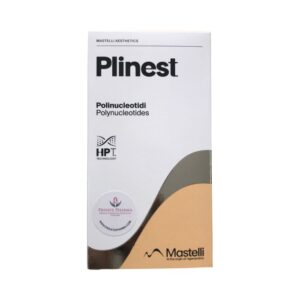
PLINEST® Regenerative Polynucleotides: The Definitive Technical Guide to PN-HPT® Dermal Matrix Engineering
In modern aesthetic medicine, cellular regeneration has largely surpassed simple symptomatic correction. While traditional hyaluronic acid fillers provide immediate, mechanical volume by expanding the extracellular matrix, they do not address the underlying biological decline of the aging dermis. Over time, chronological aging, structural tissue degradation, and UV-induced oxidative stress leave local fibroblasts dormant and deplete native collagen reserves.
To shift the clinical focus from volumetric camouflage to true biological repair, Mastelli Aesthetic (Sanremo, Italy)—the historic pioneer of DNA-based tissue recovery since 1952—engineered the Plinest® ecosystem. by their internationally patented PN-HPT® (Polynucleotides – Highly Purified Technology), the Plinest product line delivers a specific range of highly purified, variable-density polynucleotide gels. These formulations act at a deep molecular level to stimulate structural fibroblast receptors, accelerate neocollagenesis, neutralize free radical damage, and rebuild thinning skin.
For advanced dermatology clinics, high-volume medical spas, and aesthetic medicine sourcing directors, stocking the full Plinest range ensures access to a scientifically backed treatment ecosystem. Below is the complete biochemical breakdown, clinical variant matrix, delivery protocols, market comparison, and commercial guidelines for the Plinest portfolio.
The Core Science: The Regenerative Multi-Pathway of PN-HPT®
The clinical efficacy of Plinest relies on a precise extraction process that sources long-chain DNA fragments from Italian trout fish. This specific marine source yields highly concentrated polynucleotides with exceptional human tissue biocompatibility. Using Mastelli’s patented High Purification Technology (HPT™), all non-nucleic cellular proteins, pyrogens, and lipids are entirely stripped away, leaving a sterile, viscoelastic gel that triggers a multi-pathway tissue repair mechanism:
-
Fibroblast Receptor Engagement: Once placed into the dermal layer, these purified polynucleotide chains act as targeted agonists for cell-surface Adenosine receptors. This specific binding signals quiescent, dormant fibroblasts to enter an active metabolic state, shifting them into a highly productive phase.
-
Targeted Neocollagenesis & Elastin Production: Once activated, these local fibroblasts rapidly produce fresh, endogenous Type I collagen and resilient elastin fibers. This process increases overall skin thickness and significantly improves tissue elasticity and snap-back tension.
-
The Radical Scavenging Shield: The dense chemical arrangement of the polynucleotide polymer chains functions as a powerful antioxidant trap. It neutralizes reactive oxygen species (ROS) caused by lifestyle and environmental stress, shielding healthy dermal cells from ongoing oxidative degradation.
-
Isosmotic Deep Hydration: Due to their highly hydrophilic chemical structure, the long polynucleotide chains hold water molecules tightly within a three-dimensional matrix. This maintains a steady reservoir of deep isosmotic moisture, enhancing overall skin turgor and smoothness.
-
Salvage Pathway Efficiency: As the polynucleotide chains break down over time, they release free purines and pyrimidines. Local cells absorb these fragments via the “salvage pathway,” saving cellular energy and speeding up native DNA repair and cellular renewal.
The Plinest® Product Ecosystem: Calibrated Variances
The Plinest portfolio features multiple density variations, allowing practitioners to customize treatments according to anatomical thickness, tissue fragility, and specific clinical goals.
1. Plinest® (Classic / Standard)
-
Biochemical Configuration: Features a concentrated 2.0% matrix of pure, highly purified polynucleotides. Formulated without hyaluronic acid.
-
Primary Clinical Indications: Engineered to correct established photo-aging, moderate chronological wrinkles, skin roughness, dermal elastosis, and structural flaccidity.
-
Target Areas: Mid-to-lower face contours, neck lines, the décolleté region, and the backs of aging hands.
2. Plinest® Fast
-
Biochemical Configuration: A fluid, lower-density formulation containing 0.75% pure polynucleotides.
-
Primary Clinical Indications: Developed as a preventative skin booster for younger skin, sensitive or hyper-reactive skin types, early fine lines, and hair follicle support on the scalp.
-
Target Areas: Forehead, superficial cheeks, early neck wrinkles, and initial hair thinning regions.
3. Plinest® Eye
-
Biochemical Configuration: A highly fluid, low-viscosity gel specifically calibrated for delicate zones.
-
Primary Clinical Indications: Tailored to treat thin periocular skin, vascular dark circles, fine crow’s feet, and structural hollows. It is also highly effective for pre- and post-operative tissue conditioning before blepharoplasty.
-
Target Areas: Upper and lower eyelids, periorbital margins, and the tear trough zone.
4. Plinest® One / Body
-
Biochemical Configuration: Designed for broader anatomical areas, often distributed in larger 4 ml ampoules or specialized multi-vial configurations.
-
Primary Clinical Indications: Specifically formulated to improve large areas of skin laxity, soften atrophic concave scars, and visibly smooth out stubborn stretch marks (striae distendendae).
-
Target Areas: Abdomen, thighs, buttocks, upper arms, and deep fibrotic scar tissue matrices.
5. Newest® (The Hybrid Synergy)
-
Biochemical Configuration: A patented, dual-action formula combining 10 mg/mL Polynucleotides with 10 mg/mL uncrosslinked Hyaluronic Acid and a protective Mannitol stabilizer, delivered in a 2 ml pre-filled syringe.
-
Primary Clinical Indications: Designed for skin requiring immediate hydro-lifting along with long-term cellular repair. The added mannitol prevents the rapid enzymatic breakdown of hyaluronic acid while reducing post-injection swelling.
-
Target Areas: Dehydrated mature skin across the mid-face, neck, and lower face contours.
Clinical Injection Protocols and Placement Techniques
Achieving uniform cellular activation requires precise delivery into the mid-to-deep dermis, matching the specific Plinest variant to the appropriate clinical technique.
-
The Micro-Papular Mesotherapy Technique: Primarily used for Plinest Fast and Plinest Eye. Utilizing an ultra-fine 30G or 32G needle, micro-droplets are placed uniformly across the treatment zone, spaced roughly 0.5 cm apart. This method provides steady, localized nutrient diffusion to the fibroblast layers.
-
Retrograde Linear / Fan Technique: Highly recommended when treating specific structural lines, nasolabial folds, neck rings, or acne scars with Plinest Classic or Newest. The needle or a blunt 25G or 27G cannula is introduced into the dermal plane, and the gel is delivered evenly as the instrument is withdrawn.
-
The 5-Point / Bio-Aesthetic Injection Protocol: Often used with Plinest Classic or Newest across the mid and lower face. Injecting 0.1 ml to 0.2 ml into 5 strategically chosen anatomical points on each side of the face maximizes lifting benefits while minimizing local trauma, pinpoint swelling, and clinical downtime.
-
Recommended Treatment Cycles: Because cellular repair is a progressive biological process, a single session is rarely sufficient. The standard clinical protocol requires an initial round of 3 to 4 sessions spaced 14 to 21 days apart, followed by a single maintenance treatment every 6 months to maintain consistent fibroblast activation.
Technical Comparison: Plinest® vs. Leading Competitors
To help clinical owners, medical buyers, and aesthetic procurement teams curate an effective treatment menu, the table below highlights how Plinest compares with other market-leading biostimulators and tissue-remodeling systems.
| Technical Parameter | PLINEST® Range (Mastelli) | Nucleofill® (Promoitalia) | Profhilo® (IBSA) | Sculptra® (Galderma) |
| Active Substance Base | PN-HPT® (Highly purified, trout-derived polynucleotides). | Polynucleotides (PN) (Salmon-derived DNA fragments). | High & Low Molecular Weight Hybrid Hyaluronic Acid. | Poly-L-Lactic Acid (PLLA) Microparticles. |
| Primary Action Mechanism | Non-inflammatory receptor activation + salvage pathway support. | Adenosine receptor binding and free radical trapping. | Fast interstitial moisture diffusion and hydro-lifting tissue changes. | Controlled local sub-clinical inflammatory response building volume. |
| Volumetric Output | Low to None (Focuses purely on structural density and elasticity). | Minimal (Designed for biological repair and skin quality). | Intermediate (Soft hydro-contouring across tissue planes). | High (Deep neocollagenesis to restore lost fat pads and structural volume). |
| Fish / Marine Allergy Risk | Yes (Contraindicated for anyone with a known fish or trout allergy). | Yes (Contraindicated for patients with fish or salmon allergies). | No (Pure fermentation-derived uncrosslinked hyaluronic acid). | No (Synthetic, biocompatible, and biodegradable polymer). |
| Anatomical Adaptability | Exceptionally High (Calibrated options for face, body, hair, and sensitive eyes). | High (Formulations available for face, hair, body, and periorbital zones). | Moderate (Optimized for face, neck, and hands via specific BAP points). | Restrained (Strictly avoided around the delicate periorbital and perioral zones). |
Key Clinical Positioning Insights:
-
Plinest vs. Profhilo: Profhilo uses high concentrations of pure hyaluronic acid to rapidly spread moisture across tissue layers, creating an intermediate hydro-lifting effect. However, it does not contain nucleotide molecules to directly stimulate the salvage pathway or safely repair the delicate periorbital region. Plinest delivers less immediate structural volume but provides superior long-term biological repair, making it highly effective for fragile or swelling-prone under-eye areas.
-
Plinest vs. Sculptra: Sculptra relies on PLLA microparticles to cause a controlled, deep inflammatory response that builds significant structural volume over several months, making it excellent for hollow jawlines and cheeks. However, it cannot be safely injected into the superficial dermis, upper eyelids, or forehead. Plinest operates via a completely non-inflammatory pathway, offering an exceptionally safe, versatile option for superficial fine lines, thin skin textures, under-eye hollowing, and early hair restoration.
Wholesale Sourcing, Logistics, and Climate-Controlled Storage
Because achieving visible dermal restructuring and long-lasting skin refinement requires a multi-session protocol, single standalone treatments are rarely sufficient to meet patient expectations. As a result, busy aesthetic practices experience a rapid turnover of these medical devices.
Sourcing the Plinest portfolio in volume through authorized B2B wholesale platforms allows practices to unlock valuable tier discounts. Lowering the individual cost-per-syringe gives your clinic the financial flexibility to bundle competitive multi-session treatment packages, which helps secure client retention across the entire protocol while maintaining excellent clinical profit margins.
When purchasing medical devices online, clinics must maintain strict quality control and supply chain monitoring:
Storage and Shipping Requirements: Highly purified polynucleotide chains are sensitive to extreme temperature changes. Plinest inventory must be stored in a controlled environment between 2°C and 25°C, away from direct heat sources, high humidity, or freezing temperatures. Freezing conditions can fracture the delicate polymer bonds, making the biostimulating solution clinically ineffective. Sourcing managers must buy exclusively from verified wholesale distributors who provide original Mastelli batch tracking numbers, intact CE 0373 factory security seals, and climate-controlled shipping options.
Frequently Asked Questions (FAQs)
1. Is Plinest a traditional dermal filler?
No. Plinest does not contain chemically crosslinked hyaluronic acid and is not designed to create immediate artificial volume or alter natural facial features. It is an intradermal regenerative biostimulator. It works over time by delivering highly purified DNA fragments that encourage the body to produce its own collagen and elastin, naturally thickening and firming the skin from within.
2. Can Plinest be used on patients with a seafood or fish allergy?
No. Because the active PN-HPT® chains are extracted and highly purified from a trout fish source, Plinest is strictly contraindicated for individuals with a known systemic allergy to fish, shellfish, or marine products. For these patients, alternative non-marine biostimulators or pure fermentation-derived hyaluronic acid should be selected instead.
3. How quickly will patients see visible results from a treatment cycle?
Initial improvements—such as a boost in surface hydration, improved skin softness, and a brighter complexion—are often visible within the first 7 to 10 days following the first injection. However, because deep structural tissue remodeling relies on a progressive biological timeline, the most significant improvements in skin thickness, contour firmness, and fine line reduction develop over 2 to 4 weeks after the second and third sessions.
4. What is the expected post-treatment downtime for patients?
Downtime is minimal and very straightforward to manage. When utilizing the micro-papular mesotherapy technique, patients will develop small, visible bumps at the injection sites. These papules are a normal part of the process and typically resolve within 24 to 48 hours as the viscoelastic gel absorbs into the surrounding dermis. If a cannula is used via a 5-point technique, surface downtime is almost invisible, though minor pinpoint bruising may occasionally occur around fragile capillaries.
5. Can Plinest be safely combined with Botulinum Toxin or Dermal Fillers?
Yes, it pairs exceptionally well with other cosmetic treatments. While Botulinum Toxin relaxes underlying muscles to soften dynamic expression lines and dermal fillers restore lost volume in deep structural areas, Plinest repairs the biological quality of the skin tissue itself. Medical practitioners generally recommend waiting 2 weeks between treatments to allow the tissue to fully settle.
6. What are the absolute clinical contraindications for Plinest?
Plinest must never be administered to pregnant or breastfeeding women, individuals with active localized skin infections, active herpes simplex outbreaks, or open wounds in the targeted zone, or anyone with a known fish allergy. It is also completely contraindicated for individuals managing active systemic autoimmune disorders, unstable diabetes, or those undergoing current oncological therapies.
