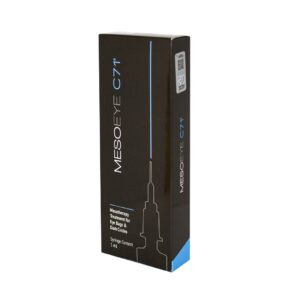
Mesoeye
Showing the single result
MESOEYE C71® Periorbital Bioremediator: The Ultimate Guide to Non-Surgical Eye Bag Resolution and Microvascular Restoration
The periorbital region is historically one of the most complex and delicate anatomical zones to treat in aesthetic medicine. The skin around the eyes is exceptionally thin, lacks abundant sebaceous glands, and rests upon a highly intricate network of blood vessels and lymphatic capillaries. As chronological aging and environmental stress progress, this microvascular network degrades. Capillary walls weaken and leak, leading to localized fluid retention, chronic edema (swelling), and the formation of dark circles caused by blood breakdown products pooling under the skin. Concurrently, the weakening of the orbital septum allows subcutaneous fat pads to herniate, resulting in prominent under-eye bags, persistent puffiness, and deep structural hollows.
Traditional treatment options often present clinical challenges. Structural dermal fillers can worsen the situation; due to the hydrophilic nature of cross-linked hyaluronic acid, placing them in the tear trough frequently leads to chronic fluid retention, severe morning puffiness, or a visible Tyndall effect. On the other end of the spectrum, surgical blepharoplasty addresses structural fat herniation but involves significant downtime, scar management, and surgical risks.
To provide an elegant, minimally invasive alternative that targets the root causes of periorbital aging, American biotechnology innovator ABG Lab engineered Mesoeye C71®. Housed in a premium, sterile syringe, Mesoeye C71 is a highly specialized periorbital bioremediator. Rather than simply filling wrinkles or artificially paralyzing muscles, it deploys a patented peptide matrix designed to repair the periorbital microvascular network, eliminate fluid stagnation, and naturally shrink herniated fat pads.
For premium medical spas, aesthetic clinics, and global wholesale distributors managing clients seeking comprehensive eye rejuvenation, keeping Mesoeye C71 in stock is a major competitive advantage. Below, we examine the biochemical science behind the C71 matrix, map out its clinical indications, contrast it with other leading eye treatments, and discuss the commercial benefits of bulk sourcing.
The Science of Mesoeye C71®: The Microvascular Tri-Peptide Matrix
The clinical success of Mesoeye C71 lies in its targeted mechanism of action. Instead of relying purely on hydration, it combines three highly specific bio-engineered components that work synergistically to repair the periorbital micro-environment:
-
PeriOrbital Peptide XP21®: This patented synthetic peptide targets the localized blood vessels. It relaxes arterial walls, helping to restore normal blood flow and reduce vascular spasms. More importantly, it helps prevent and reverse the pathological leaking of fluids from capillaries, directly reducing the primary cause of chronic under-eye puffiness and dark shadows.
-
Hexapeptide-17®: A powerful lymphatic activator. This peptide binds to specific receptors on lymphatic vessels, dramatically accelerating microcirculation and the removal of stagnant fluids. By clearing away built-up toxins and cellular waste, it lifts chronic periorbital edema and slims down heavy under-eye bags.
-
DRMC Complex (Dermato-Remodeling Matrix Complex): A sophisticated nutritional base containing non-crosslinked hyaluronic acid ($0.4\%$), over 50 amino acids, essential vitamins, nucleoside bases, and coenzymes. This complex provides the structural building blocks for young fibroblasts to synthesize fresh collagen and elastin, firming up the fragile periorbital skin matrix.
Targeted Clinical Indications and Patient Profiles
Mesoeye C71 is supplied as a sterile, ready-to-use $1.0\text{ mL}$ syringe, explicitly formulated to safely treat the upper and lower eyelids, as well as the lateral canthal area (crow’s feet).
-
Chronic Periorbital Puffiness and Edema: Flushes out fluid retention and persistent morning swelling beneath the eyes.
-
Herniated Under-Eye Bags (Early Stage): Safely tones and shrinks the appearance of localized fat pad protrusions without surgery.
-
Vascular Dark Circles: Restores capillary health to fade dark brown, blue, or purple discoloration beneath the lower eyelids.
-
Structural Periorbital Wrinkles and Fine Lines: Firms up thin, crêpey skin texture and smooths out static crow’s feet.
-
Post-Blepharoplasty Rehabilitation: Speeds up tissue recovery, reduces lingering post-op swelling, and improves overall skin elasticity following eyelid surgery.
Clinical Placement Protocols and Injection Techniques
Because the periorbital region houses fragile anatomical structures, administering Mesoeye C71 requires precise depth calibration and specialized injection techniques.
-
The Micro-Papular Meso Technique (For Skin Quality): Utilizing an ultra-fine 32G or 33G needle, the practitioner delivers tiny micro-papules into the superficial dermis around the crow’s feet and across the lower eyelid skin, spacing points 2 mm to 3 mm apart.
-
Deep Infiltration Technique (For Eye Bags): To target herniated fat pads and stagnant fluid pockets, the needle is introduced perpendicularly at a depth of 4 mm directly into the lower eyelid fat compartments, delivering a slightly larger aliquot.
-
The Recommended Treatment Matrix: Because microvascular repair operates on a progressive biological timeline, maximum clinical outcomes require a structured series. A standard protocol consists of 3 to 6 initial sessions spaced 10 to 14 days apart, followed by a maintenance session every 4 to 6 months to support vascular health.
Competitive Brand Analysis: Mesoeye C71 vs. The Competition
To assist procurement managers, clinic owners, and medical directors in organizing an effective clinical menu, it is helpful to analyze how Mesoeye C71 compares to traditional tear trough fillers and alternative periorbital skin boosters like Redensity 2®, Lumi Eyes®, and Nucleofill Eyes®.
| Brand | Primary Active Matrix | Primary Mechanism of Action | Post-Treatment Swelling Risk | Target Clinical Concerns |
| MESOEYE C71® | PeriOrbital Peptide XP21 + Hexapeptide-17 + DRMC. | Microvascular repair, lymphatic drainage, and fat pad toning. | Extremely Low (Active peptides work to reduce fluid retention). | Chronic under-eye puffiness, fluid eye bags, dark circles, and fine lines. |
| Teosyal Redensity 2® | Semi-Crosslinked HA + Amino Acids & Minerals. | Mechanical space-filling and structural volume restoration. | Moderate to High (Hydrophilic HA can cause swelling if over-injected). | True structural tear trough hollows and deep volume deficits. |
| Dermaren Lumi Eyes® | Purified Polynucleotides (PDRN) from salmon DNA. | Fibroblast activation, tissue regeneration, and healing. | Low (Triggers minimal fluid retention). | Delicate skin thinning, dark circles, and dry under-eye skin. |
| Nucleofill Eyes® | High-density Polymerized Polynucleotide Gel. | Deep tissue biostimulation and free radical scavenging. | Low to Moderate (Temporary initial firmness can occur). | Significant skin laxity, periorbital drooping, and structural lines. |
Key Takeaways for the Practitioner:
-
Mesoeye C71 vs. Tear Trough Fillers: Traditional fillers like Redensity 2 are exceptional for replacing lost volume in deep structural hollows. However, if a patient presents with fluid puffiness or herniated eye bags, cross-linked fillers can absorb water and worsen the swelling. Mesoeye C71 is the ideal corrective alternative; instead of adding volume, it restores vascular flow and drains fluid, making it perfect for puffy, tired-looking eyes.
-
Mesoeye C71 vs. Polynucleotide Boosters: Products like Lumi Eyes and Nucleofill use salmon-derived DNA fragments to activate fibroblasts and thicken thin, fragile skin. While excellent for skin texture, they lack specific vaso-active and lymphatic-draining peptides. Mesoeye C71 is unique because it directly targets the microvessels, allowing it to clear vascular discoloration and flush out chronic puffiness that general biostimulators cannot resolve.
Wholesale Sourcing and Inventory Management for Clinical Success
Because restoring microvascular health and reducing periorbital edema relies on a cumulative, multi-session protocol, standalone single sessions are rarely sufficient to meet a patient’s goals. High-volume aesthetic clinics and anti-aging centers experience a fast turnover of these specialized syringes.
Purchasing Mesoeye C71 wholesale through established medical e-commerce channels offers significant volume discounts. Minimizing your individual cost-per-syringe gives your practice the financial flexibility to bundle highly attractive, multi-session periorbital treatment packages. This approach helps retain clients over their full protocol while securing excellent profit margins for the clinic.
When sourcing Mesoeye online, strict quality assurance and logistical safety parameters must be maintained. True Mesoeye C71 utilizes highly sensitive, bio-engineered peptide matrices and nutritional complexes that must be stored properly—ideally refrigerated between 2°C and 8°C—to prevent protein denaturation and maintain structural stability. Medical practices should purchase exclusively through authorized, licensed aesthetic supply distributors who guarantee authentic original syringes from ABG Lab, unadulterated batch tracking numbers, pristine vacuum packaging seals, and climate-controlled logistics.
Frequently Asked Questions (FAQs)
1. Is Mesoeye C71 a dermal filler or a neurotoxin?
No, it is neither. Mesoeye C71 does not contain cross-linked hyaluronic acid designed to create artificial mechanical volume, nor does it contain botulinum toxin to paralyze periocular muscles. It is a highly specialized periorbital bioremediator. It works over time by repairing damaged microvessels, improving lymphatic drainage, and reinforcing the skin’s natural structure.
2. Can Mesoeye C71 safely treat both the upper and lower eyelids?
Yes, absolutely. Because of its safety profile and gentle, non-crosslinked formulation, Mesoeye C71 can be safely injected across the entire periorbital matrix. This includes the delicate skin of the upper eyelids up to the tarsal plate, the lower eyelids down to the orbital rim, and the lateral canthal zones where crow’s feet develop.
3. How quickly do visible improvements appear after a session?
Initial changes—such as a reduction in morning under-eye puffiness, improved skin hydration, and a brighter, more rested look—typically become visible within 3 to 5 days post-injection as the lymphatic drainage process accelerates. Deeper structural changes, including the clearing of dark circles and firmer skin texture, develop progressively over 4 to 6 weeks as the periorbital vascular network stabilizes.
4. What is the typical patient downtime after a treatment?
Downtime is minimal and very straightforward to manage. Because the product is administered using micro-needles, patients will experience small, temporary papules or light swelling in the treated areas. These minor side effects are completely normal and typically resolve within 12 to 24 hours as the solution absorbs. Pinpoint bruising around delicate capillary zones can occasionally occur but can be easily concealed with light makeup.
5. Can Mesoeye C71 be combined with botulinum toxin treatments?
Yes, combining these treatments is highly effective. While botulinum toxin relaxes dynamic muscles to smooth out active crow’s feet, it does not improve skin thickness or address vascular dark circles and puffiness. Administering Mesoeye C71 alongside or between neurotoxin appointments allows practitioners to treat both muscular wrinkles and underlying vascular aging at the same time.
6. What are the absolute contraindications for Mesoeye C71 bioremediation?
Mesoeye C71 must never be administered to pregnant or breastfeeding women, individuals with a known history of severe anaphylaxis or hypersensitivity to any peptide or vitamin within the formula, or patients with active local skin infections, herpes outbreaks, or open wounds around the eyes. It is also completely contraindicated for individuals managing active systemic oncological treatments or unstable auto-immune disorders.